
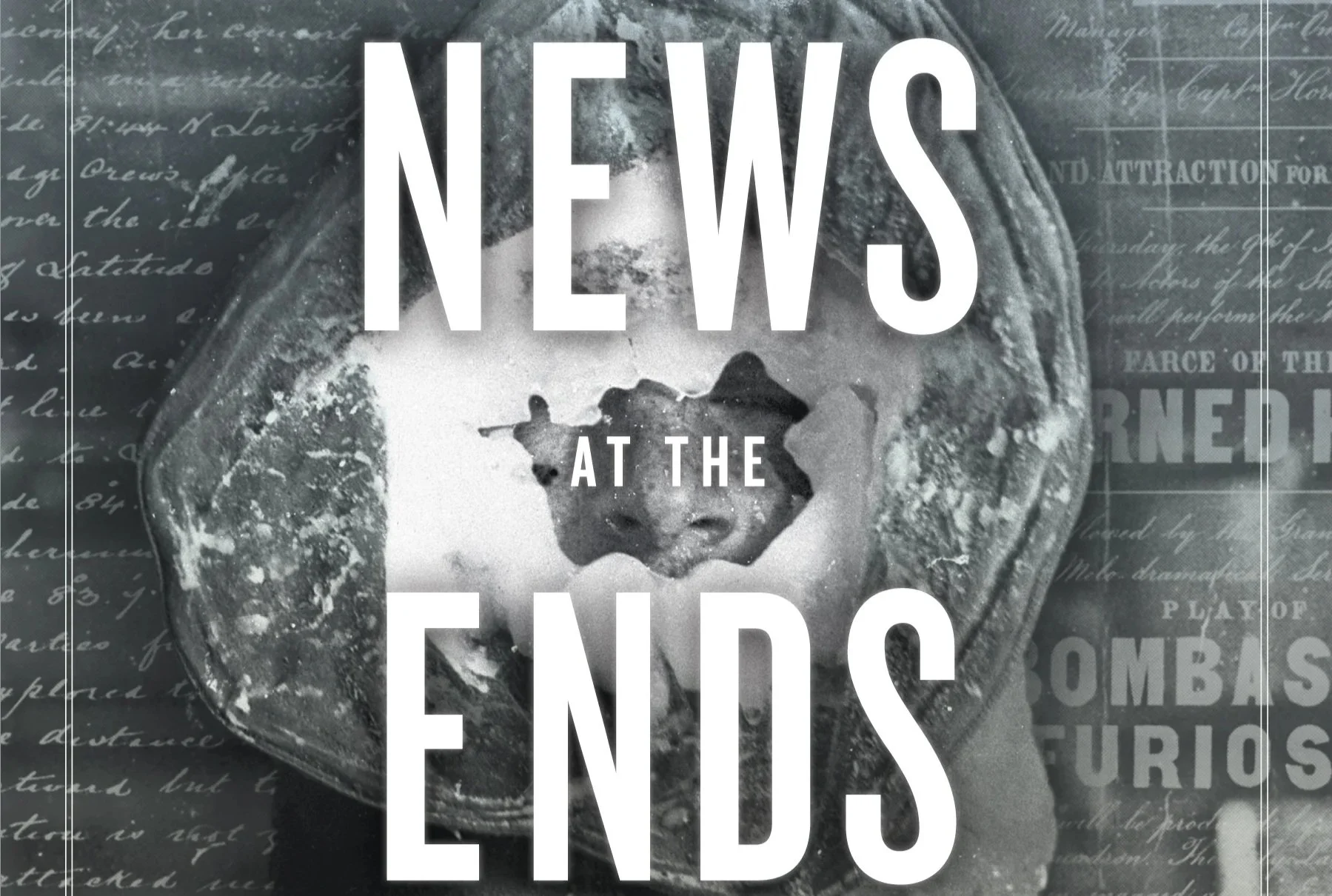
The News at the Ends of the Earth
Hester Blum, The News at the Ends of the Earth: The Print Culture of Polar Exploration (Durham: Duke University Press, 2019).
Description:
From Sir John Franklin's doomed 1845 search for the Northwest Passage to early twentieth-century sprints to the South Pole, polar expeditions produced an extravagant archive of documents that are as varied as they are engaging. As the polar ice sheets melt, fragments of this archive are newly emergent. In The News at the Ends of the Earth Hester Blum examines the rich, offbeat collection of printed ephemera created by polar explorers. Ranging from ship newspapers and messages left in bottles to menus and playbills, polar writing reveals the seamen wrestling with questions of time, space, community, and the environment. Whether chronicling weather patterns or satirically reporting on penguin mischief, this writing provided expedition members with a set of practices to help them survive the perpetual darkness and harshness of polar winters. The extreme climates these explorers experienced is continuous with climate change today. Polar exploration writing, Blum contends, offers strategies for confronting and reckoning with the extreme environment of the present.
An open access version is available.
Finalist, Ecocritical Book Award, Association for the Study of Literature and Environment
Named CHOICE Outstanding Academic Title, 2019
Reviewed in Times Literary Supplement, Edge Effects, Choice,Nimrod, Studies in Travel Writing, Cultural and Social History, The Nautilus, Nineteenth-Century Literature, Public Books, International Journal of Maritime History, Victoriographies, Journal of World History, The Polar Journal, Victorian Periodicals Review, Journal of American Studies, Journal of European Periodical Studies, Journal of American Culture, Victorian Studies, Journal of Environmental Media, Journal of American History
“What Hester Blum describes here is the production of print culture for the sake of not going crazy, for the sake of remaining, in some recognizable and accountable sense, human. This is media production under extreme duress, which makes for a fascinating story and theoretical provocation. Founded on a thought-provoking and unique archive and busting with insight, The News at the Ends of the Earth is a terrific book.” - Stephanie LeMenager, author of Living Oil: Petroleum Culture in the American Century
“Using archives from Europe, Australia, and New Zealand as well as from North America, this pioneering work tells an unforgettable story about ship newspapers and other improvised media produced by sailors on Arctic and Antarctic expeditions. Informed by indigenous knowledge and bearing witness to the extreme conditions of the polar regions, this invaluable material sheds light on the extreme weather of the Anthropocene as much as on the print culture of the nineteenth century. Labor-intensive, detail-rich, and eye-opening.” - Wai Chee Dimock, Yale University
”The News at the Ends of the Earth is a fine-grained register of the ebb and flow of a printophilic century, from Ross to Shackleton. While mindful of the minor variations over the decades, Blum marvelously conveys that fantastic, phantasmatically preserved shipbound conversation, a dilated and heterogeneous house party.” - John Plotz, Public Books
”An intricately layered, richly illustrated examination of shipboard newspapers (printed and handwritten), playbills, and other media produced by expeditions to the Antarctic and Arctic regions between 1818 and 1914. . . . The book speaks to the human imperative to communicate, even under extremely hostile conditions. . . . Essential. Upper-division undergraduates through faculty.” - J. Bekken, Choice
”Superb. . . . As the Anthropocene continues to develop, Blum’s concern with the media and narratives we might use to represent the planet’s predicament is of interest not only to scholars of printing and the polar regions, but also to a general reader.” - Nancy Campbell, TLS
”I’m certain that Hester Blum’s effort will stand the test of time as the authoritative treatment of this captivating subject.” - Robert B. Stephenson, Nimrod: The Journal of the Ernest Shackleton Autumn School
”[Blum] offers a fascinating history of onboard polar publication and provides a detailed analysis of the various textual materials produced during voyages of Arctic and Antarctic exploration. It also strives to unpick the intriguing motivations that lay behind their production. ... An invaluable contribution to several branches of scholarship, and readers interested in polar exploration, literary studies, and histories of printing culture will gain much from reading this interesting and insightful book.” - Peter R. Martin, Nineteenth Century Studies
”For readers interested in the culture of polar exploration, The News at the Ends of the Earth is an indispensable guide to the inner workings of expeditionary communities.” - Janice Cavell, International Journal of Maritime History
”The News at the Ends of the Earth makes a significant contribution to the growing push to incorporate the polar regions into world histories. It would be of immense value to historians with an interest in oceanic spaces, the polar regions, histories of printed media, or histories of ephemera, and would be a useful starting point for scholars looking to think about how the Arctic and Antarctic fit into the scope of world history.” - Rohan Howitt, Journal of World History
“The reader is … awestruck not by the aurora borealis but by the scope of Blum’s reading and her ability to personify (in the literary sense of characterization) the constraints and triumphs of what we might otherwise think of as a rather mundane group of somewhat literary explorers and scientists.” - R. D. Madison, The Nautilus
“The News at the Ends of the Earth is as ambitious a volume as the pieces it represents. . . . In our contemporary era of digital archives and media, a volume such as this is rendered more valuable.” - Ellen C. Frye, The Polar Journal
“The News at the Ends of the Earth succeeds in its assertion that the practices of historical polar expeditions are important in comprehending the current climate crisis. The reader is left with an overwhelming sense of how crucial the enterprise of creating these collective outlets of communication was, and still is, in understanding one’s place in the environment and the necessity of self-expression in climatic extremes.” - Eavan O’Dochartaigh, Journal for Maritime Research
“The News at the Ends of the Earth leaves us with a challenge: find a new ecomedia for narrating our survival in increasing extremity.” - Helena Goodwyn, Victorian Periodicals Review”